In memory of Alfred Brendel
‘If I belong to a tradition,’ the late Alfred Brendel once remarked, ‘it is a tradition that makes the masterpiece tell the performer what he should do, and not the performer telling the piece what it should be like’. This profound statement cuts to the heart of musical artistry. The composer’s wishes, the work’s emotional and structural roadmap, are not hidden in some esoteric code; they are encoded in the thousands of small details contained in the score. The path from a student who can play the notes to an artist who can move an audience is paved with meticulous, conscious attention to these details. This is not an advanced, final-polish skill, but the fundamental basis of all good piano-playing, from the very first lesson.
In this post, I will deconstruct the anatomy of musical expression by examining its foundational details. I will then offer a toolkit for practising these elements effectively. Ultimately, my goal is to show that the details are not a chore to be endured, but the very substance of music itself.
The Anatomy of Musical Detail – The Building Blocks of Expression
Before we can master the details, we must first learn to see them. A musical score is a dense tapestry of information. To the novice, the score can look like an endless web of individual markings strung together. To the artist, though, it is a detailed blueprint for curating an emotional experience. The following components are the essential threads of this tapestry.
The Foundation: Technique, Touch, and Tone
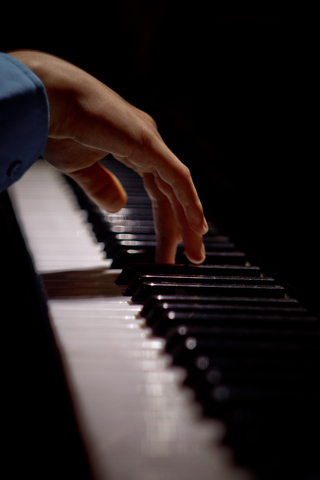
Technique is not about playing fast; it is the physical vehicle for artistic expression. It is the foundational skill that allows a pianist to translate musical ideas into sound, with the primary goal being the production of a beautiful, controlled tone. The details here begin with the body itself. Proper posture—sitting up straight with feet flat on the floor—and correct hand position—with relaxed, curved fingers and level wrists—are not just suggestions for looking professional. They are the biomechanical prerequisites for efficient, tension-free playing. Ignoring these physical fundamentals can cause tension to accumulate in the shoulders, arms, and wrists. This tension directly results in a harsh, uncontrolled sound, and inhibits the free movement necessary for advanced playing. This can, furthermore, lead to physical strain and career-ending injuries like tendonitis, focal dystonia, or carpal tunnel syndrome.
This reveals a direct causal link that is often missed by aspiring pianists. A failure to address the most basic physical details—a slouched posture, a tense wrist—creates a hard ceiling on artistic growth. This physical tension makes it impossible to execute the fine motor commands required for nuanced dynamics, articulation, and phrasing. The devil of a sloppy posture becomes the devil that silences your musical voice. The pianist must learn to use the natural weight of the arm, channelled through a firm but flexible hand, to caress the key and produce a rich, resonant tone.
Choreography: The Art of Fingering
Fingering is the choreography of the hand. Consistent, intelligent fingering is as crucial as the notes themselves because it is the mechanism through which muscle memory is built, ensuring consistency, enabling speed, and providing musical security. Using a different fingering every time you play a passage forces your brain into a state of perpetual indecision, leading to hesitation, inaccuracy, and a disrupted flow.
Good fingering is based on principles of preparation and ergonomics. It anticipates what comes next, such as the classic thumb-tuck in a scale (e.g., 1-2-3-1-2-3-4-5) that positions the hand to continue the passage smoothly. Good fingering avoids awkward crossings (like finger 3 over 5) and the inefficient use of the shorter digits on the black keys (which are shorter) —thus requiring a more exaggerated shift towards the fall-board. It also demands the use of all five fingers, rather than relying on a few strong ones. While standard fingerings for scales and arpeggios provide a starting point, the best fingering is always contextual, and an editor’s suggestion may need to be adapted to an individual’s hand.
Articulation and Dynamics
Articulation (how notes are connected or separated, such as legato and staccato) and dynamics (variations in volume) are the inflection of musical language. They create character and mood. One of the most common and damaging practice mistakes is the ‘add expression later’ fallacy. Students often focus on learning notes and rhythms first, planning to add dynamics and articulation after the piece is ‘learned’. This is fundamentally inefficient because it forces the pianist to learn the piece twice, retraining the physical motions and muscle memory that have already been ingrained. Expression is not an overlay; it is integral to the music’s structure from the very beginning.
Furthermore, these markings correspond to specific physical gestures. Legato is not merely ‘connected’; it involves the physical act of transferring weight from one finger to the next in a single, flowing gesture. Staccato is not just ‘short’; it is often executed with a specific hand or wrist motion, a ‘light bounce’. Dynamics are the emotional core of the music, shaping phrases and communicating feeling. Ignoring them is like reading poetry in a monotone.
The sooner these details are incorporated into practice, the more quickly the music will make sense, and the more easily it will be learned.
The Grammar: Phrasing and Voicing
Phrasing is the art of grouping notes into musical ‘sentences’ to create a compelling narrative. Voicing is the skill of controlling the dynamic balance between different musical lines—or even within a single chord—to bring out the most important elements. Music is its own language, and a musical phrase has a beginning, a peak, and an end, just like a spoken sentence. A powerful way to discover natural phrasing is to sing the melodic lines. The places where you naturally breathe, swell in volume, or relax will inform your shaping at the piano.
Voicing, on the piano, most often means making the melody ‘sing’ above the accompaniment. This requires extraordinary control, ensuring the top note of a chord is played with more weight and intention than the notes below it. In contrapuntal music, such as a Bach fugue, every voice is a melody and must be balanced with equal care. At higher levels, I would actually argue that all piano music is polyphonic, if not strictly speaking contrapuntal. This control over balance, combined with touch and pedalling, creates what is known as ‘tone colour’. Emphasising higher notes can create a ‘brighter’ colour, while bringing out lower notes can create a ‘darker’ one, allowing the pianist to emulate orchestral sonorities.
Rhythm and Pedalling
If notes are the bricks, rhythm is the mortar that holds the entire structure together. Rhythmic integrity is non-negotiable. The metronome is an indispensable tool for developing a stable internal pulse, ensuring technical precision, and mastering tempo control. Ignoring rhythm makes even the most beautiful melody sound chaotic.
The damper pedal, often called ‘the soul of the piano’, is perhaps the most misunderstood detail of all. Its purpose is to create resonance, colour, and connection—not to mask technical insecurities or an uneven legato. Common mistakes abound: over-pedalling, which creates a ‘muddy’ sound where harmonies clash; ‘horse pedal’, where the entire foot lifts from the floor, causing a disruptive gap in the sound, in extreme cases even a percussive thud—and incorrect timing. The correct ‘syncopated’ or ‘legato’ pedalling technique—where the pedal is lifted and re-depressed swiftly after each new harmony is played—is a crucial detail to master. Beyond this, advanced techniques like half-pedalling (partially clearing the dampers) and flutter-pedalling (a rapid sequence of continuous half-pedal changes) are essential for creating the atmospheric effects required by composers like Debussy.
The Microscope – A Guide to Meticulous Practice
Knowing what the details are is only half the battle. The other half is knowing how to practise them. Effective practice is not about logging hours; it is about the quality and focus of the attention brought to each minute at the keyboard.
The Detective’s Mindset: Deconstruction and Slow Practice
The most common and destructive practice mistake is playing too fast, which only serves to ingrain errors. This is not merely inefficient; it is actively counter-productive. Practice is the process of building and reinforcing neural pathways to create muscle memory. When a student plays a passage quickly and makes mistakes, they are diligently practising and strengthening the wrong physical motions. To fix this, the student must unlearn the incorrect habit before they can build the correct one. Therefore, practising slowly and accurately from the start is exponentially more efficient. Rushing is, quite literally, negative progress.
Slow practice is the ‘magic’ that allows the brain and fingers to process every detail: correct notes, fingering, articulation, and dynamics. It requires the mindset of being a detective, taking the piece apart to understand how it works. Actionable strategies include:
- Sectioning: Break the piece into the smallest possible chunks, even just one or two bars. Master each chunk before connecting them.
- The 80/20 Rule: Spend 80% of your practice time on the hardest 20% of the music.
- Hands-Apart Practice: This is vital. Practice each hand alone until it is completely secure before attempting to combine them.
- Start at the End: Avoid starting each practice session at the beginning of the piece. Learning the piece progressively from beginning to end usually means that the beginning is practised exponentially more than the end. As a result, the performance moves from the most secure to the least secure section.
Cultivating the Inner Ear: Active Listening and Mental Rehearsal
Practice is not a mindless physical drill but a highly cognitive activity. Many students equate practice time with time spent physically at the piano, but the anecdotes of masters practising fewer hours as they mature suggest a shift in how they practice. The effectiveness of practice is directly proportional to the degree of active mental engagement. Twenty minutes of focused, analytical work is more valuable than two hours of passive, repetitive playing.
This active engagement begins with active listening. The mistake of ‘not listening’ is common. It means playing on autopilot, oblivious to the actual sound being produced. Active listening involves constantly assessing your own playing: Is the tone beautiful? Is the voicing clear? Are the dynamics what I intended? Recording your practice sessions provides invaluable, objective feedback.
An even more advanced form of active practice is mental rehearsal. The ability to play the music in your mind, away from the instrument, is a technique used by the greatest musicians. It strengthens memory, clarifies your interpretation of every detail, and allows you to practise perfectly without any physical limitations. In the most advanced case, you should be able to ‘imagine’ your way through your entire recital programme without touching a single key.
The Teacher’s Role: From Mistake Police to Practice Coach
The teacher’s role is not just to identify wrong notes but to teach the process of effective practice. Telling a student to practise without teaching them how is like a doctor telling a patient to lose weight without offering them any dietary advice. Teachers must shift from being the note police to empowering students to become their own teachers during the time between lessons. This can be achieved with practical tools. Explicitly teaching a practice strategy, like sectioning, during the lesson, and then asking the student to explain it back, will ensure comprehension.
(If you have explored the Learn section of this website you will probably have noticed that I prefer the term ‘coaching’ to ‘teaching’, for this very reason.)
Finding Joy in the Process
The phrase ‘the devil’s in the details’ implies that something that may at first glance appear easy can contain small, intricate nuances, which are the difficult parts that need to be managed. It also emphasises the importance of thoroughness; it reminds us that a successful outcome depends on carefully addressing every small element, not just the big picture. The phrase can also suggest that details are a tedious, frustrating burden. But in music, the real devil is not the detail, but inattention to it. The act of engaging deeply with the small components of a piece—of shaping a phrase, balancing a chord, perfecting a pedal change—is where the divine spark of artistry is found.
The ultimate reward of this meticulous work is not just a flawless performance, but a deeper understanding of and connection to the music. It is the transformation of practice from a chore into what pianist Jeremy Denk calls a ‘joy in itself’, an ‘act of translating through the body that I somehow need… to feel complete’. The path is long and requires immense patience and discipline. But the satisfaction of true craftsmanship—of becoming a faithful servant to the music—is one of the most profound experiences a musician can have. The details are not obstacles on the path; they are the path itself.