- Quiet Power: Micro-Gestures and the Art of True Expression
 There is a common tendency to dissociate ‘technique’ and ‘musicality’. Technique is mechanical, while musicianship is expressive. However, I would posit that technique is merely the physical and mental means by which musicians reliably, consistently, and safely, communicate their understanding (some would say ‘interpretation’) of a piece of music to their listeners. As proof of… Read More »Quiet Power: Micro-Gestures and the Art of True Expression
 - The Devil’s in the DetailsIn memory of Alfred Brendel ‘If I belong to a tradition,’ the late Alfred Brendel once remarked, ‘it is a tradition that makes the masterpiece tell the performer what he should do, and not the performer telling the piece what it should be like’. This profound statement cuts to the heart of musical artistry. The… Read More »The Devil’s in the Details
- The Solo Piano Works of Georges Bizet
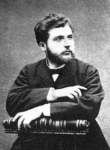 On this day exactly 150 years ago, the French composer Georges Bizet died from a heart attack. He was 36 years old. He never saw the enormous success of his opera Carmen, and went to his grave believing himself a failure. This post explores the composer’s small output for the piano; and I will go… Read More »The Solo Piano Works of Georges Bizet
 - Ravel’s Solo Piano Music, part 1
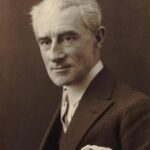 The Young Alchemist (1893–1901): Forging a New Pianism Early Experiments: Spanish Grotesques and Antique Dances (1893-1895) Although Ravel’s compositional voice did not emerge fully formed, his earliest surviving works show a remarkably clear vision. The Sérénade grotesque of 1893, written when he was just 18, is a fascinating first draft of the Spanish idiom that… Read More »Ravel’s Solo Piano Music, part 1
 - Featured composer: Cécile Chaminade – repertoire update
 Since I first started my exploration of Chaminade’s music from the UK diploma syllabuses, the ABRSM has released updated repertoire lists. The table below reflects the new contents: Sonata in C minor, second movement op. 21 W23 DipLCM Sonata in C minor, complete op. 21 W23 ATCL, LRSM Étude symphonique op. 28 W32 LLCM Six… Read More »Featured composer: Cécile Chaminade – repertoire update
 - The Faun and the Clockmaker: Claude Debussy, Maurice Ravel, and the Impressionist LabelThe Dawn of a New Sound: Debussy and the Aesthetics of Musical Impressionism To comprehend the persistent, yet often imprecise, association of Maurice Ravel with musical Impressionism, we must first establish a clear understanding of the movement itself and its undisputed progenitor, Claude Debussy. The term ‘Impressionism’ in music was not a self-proclaimed manifesto but… Read More »The Faun and the Clockmaker: Claude Debussy, Maurice Ravel, and the Impressionist Label
- A Pianist’s Guide to the Solo Works of Maurice RavelOn this day 150 years ago, Maurice Ravel, one of my absolute favourite composers, was born in Ciboure, a Basque town some ten miles from the Spanish border. To celebrate this anniversary, over each of the next six months, I’ll be posting about a work or group of works for solo piano. There’s also an… Read More »A Pianist’s Guide to the Solo Works of Maurice Ravel
- The Lazarus Complex
 Posthumous Discovery, Mediated Authorship, and the Musical Denial of Finality As yet another birthday passes, my thoughts once again turn towards the ever-closer shuffling off of my mortal coil. Still some way off, I hope, but there we go. Coupled with this, is the news that, trailing clouds of glory, composers never die. Some of… Read More »The Lazarus Complex
 - Unfit for Intellectual Effort: Critical Condemnations of Salon Music in the 19th and 20th Centuries
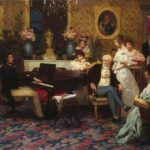 The Paradox of the Parlour Throughout the nineteenth century, a particular genre of music flourished, not in the grand, newly constructed concert halls of Europe, but in the intimate drawing-rooms of the burgeoning bourgeoisie. This was ‘salon music’, a category of composition primarily written for the solo piano, designed to be performed in the semi-private… Read More »Unfit for Intellectual Effort: Critical Condemnations of Salon Music in the 19th and 20th Centuries
 - In Defence of ‘Salon Music’: the Legacy of a Misunderstood GenreIt is almost a dirty word, a label for a kind of polite, facile music, written for the bourgeoisie, lacking the heft of more serious, ‘canonical’ works. This is ‘salon music’, and to mention it in the same breath as a Beethoven sonata or a Mahler symphony is, for some, a mark of musical illiteracy.… Read More »In Defence of ‘Salon Music’: the Legacy of a Misunderstood Genre
- Unleashing Velocity: A Scientific Approach to Playing FastIn my previous post, I looked at the advantages of slow practice. Here, I examine how to build on that foundation, and how practising fast is just as vital to building virtuosity. The Speed Trap: Why Your Slow Practice Isn’t Making You Faster Every dedicated piano student has encountered it: the ‘speed wall’. It is… Read More »Unleashing Velocity: A Scientific Approach to Playing Fast
- The Slow Practice Manifesto: Building an Unshakeable Foundation at the KeyboardThe Pianist’s Paradox: Why the Path to Speed is Paved with Slowness In the world of piano pedagogy, there is a central, counter-intuitive truth that separates the amateur from the master: the path to effortless velocity is paved not with frantic, repetitive drilling at speed, but with meticulous, mindful, and often excruciatingly slow work. This… Read More »The Slow Practice Manifesto: Building an Unshakeable Foundation at the Keyboard
- Cecile Chaminade: ‘Marine’, op. 38
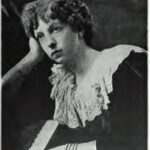 Like many of Chaminade’s solo piano works, Marine, op. 38, is in ternary form—the A section being repeated literally before leading to a coda. Gratefully written, it exploits the full range of tone-colour offered by the piano, from the sonorous depth of the bass to glistening arabesques in the upper register. The title, somewhat vaguely… Read More »Cecile Chaminade: ‘Marine’, op. 38
 - Chord-playing: ‘shape’ and ‘position’
 Playing sequences of chords, particularly when they’re faster, can often be a stumbling block for younger or less advanced pianists. In this post, I’m going to share with you an approach to chord-playing that I think helps, mainly by clarifying the issue and thereby giving us a way into teaching and practicing chords in a… Read More »Chord-playing: ‘shape’ and ‘position’
 - The Myth of Weak FingersIt is commonly supposed among us pianists that the ring finger—our ‘fourth’ finger, ever since the ‘English’ fingering system was by and large superseded by the ‘continental’ system—is the weakest. This has evolved into a separation of the ‘outside’ and ‘inside’ fingers, those further from or closer to the thumb respectively, and the categorisation of… Read More »The Myth of Weak Fingers
- Franz Liszt: La cloche sonne
 Although I rarely have cause these days to paddle in the balmy waters of the lower grades of the ABRSM syllabus, a little piece on the 2023-24 Grade 4 set works list caught my eye, and so I wanted to share my thoughts on it, for various reasons. First, of course, it’s a nicely-crafted little… Read More »Franz Liszt: La cloche sonne
 - Edvard Grieg: ‘Elegy’, no. 7 from Lyric Pieces, Op. 47
 ‘Elegy’, Op. 47 No. 7, the final piece in the fourth book of Lyric Pieces, published around 1888, presents challenges that are more musical than purely technical. This piece is a prime example of Grieg’s ability to convey deep feeling within a concise form. Grieg establishes the melancholic and brooding atmosphere from the outset, and… Read More »Edvard Grieg: ‘Elegy’, no. 7 from Lyric Pieces, Op. 47
 - Edvard Grieg’s ‘Little Bird’, op. 43 no. 4My survey of my favourite Grieg Lyric Pieces continues with ‘Little Bird’, from the op. 43 set. Originally titled Fruhlingslieder (Spring Songs) and first published in 1887, this set focuses on the theme of nature, and is a highlight of the entire collection. Choosing just one piece from this album is a real challenge! But… Read More »Edvard Grieg’s ‘Little Bird’, op. 43 no. 4
- Cécile Chaminade: ‘Automne’, op. 35 no. 2Undoubtedly one of Chaminade’s most well-known and well-loved solo piano works, ‘Automne’ comes from the collection Études de Concert, op. 35. No fewer than four of the six etudes that comprise the set feature on diploma works lists. They are all gratefully written, and although they deserve the ‘etude’ title, their musical interest and audience… Read More »Cécile Chaminade: ‘Automne’, op. 35 no. 2
- Edvard Grieg: ‘Elf-Dance’, no. 5 from Lyric Pieces, op. 12Inspired by the folklore of his native Norway, Grieg’s ‘Elf-Dance’ is a scherzo-like movement which exemplifies many aspects of Grieg’s early piano writing. Most often female, elves in Norse legend are mainly to be encountered at night or in the mists of early morning, dancing in groups, leaving behind ‘elf-circles’. Frequently associated with illness or… Read More »Edvard Grieg: ‘Elf-Dance’, no. 5 from Lyric Pieces, op. 12
- My top ten Grieg Lyric PiecesThe ten sets of Grieg’s Lyric Pieces encapsulate the composer’s entire creative development. The pieces collectively summarise many of the typical concerns of the later Romantic era—nature, nationalism, nostalgia, programme music, a taste for the miniature or fragmentary—and demonstrate Grieg’s cultivation of a personal and, as it were, recognisably Nordic musical dialect, namely, one of… Read More »My top ten Grieg Lyric Pieces
- Cécile Chaminade: Piano Sonata, op. 21, second movementWe begin our survey of Chaminade’s diploma-level piano works with the middle movement of her only piano sonata. Published in 1895, it is dedicated to Moritz Moszkowski, Chaminade’s brother-in-law. Marcia J. Citron cites a performance of the first movement given two years before the work was published by the composer herself in St. James’s Hall,… Read More »Cécile Chaminade: Piano Sonata, op. 21, second movement
- Perfect PracticeOne of the greatest pleasures and privileges of my career has been to work with dancers. For anyone interested in how to achieve excellence—perfection in dance being a platonic ideal strived for but never quite attained—a lot can be learned from time regularly spent in a dance studio. The following idea I attribute to the… Read More »Perfect Practice
- Problem-Solving Problems(for Ted Hill) Sometimes things get better with patience, practice, and time. Sometimes, though, they don’t, and more extreme action is required. While medical metaphors are probably the last thing anyone wants to contemplate as we all emerge blinking into the blinding post-Covid light without even so much as a mask and a litre of… Read More »Problem-Solving Problems
- Featured composer: Cécile Chaminade (1857-1944)The French composer Cécile Chaminade features in both LCM and TCL diploma syllabuses, appearing in the repertoire lists for DipLCM, ALCM, LLCM, and ATCL. This is not a token nod, either, as the choice of works by Chaminade is more than double that of those by Amy Beach, Miriam Hyde, Clara Schumann, or those by… Read More »Featured composer: Cécile Chaminade (1857-1944)