
Posthumous Discovery, Mediated Authorship, and the Musical Denial of Finality
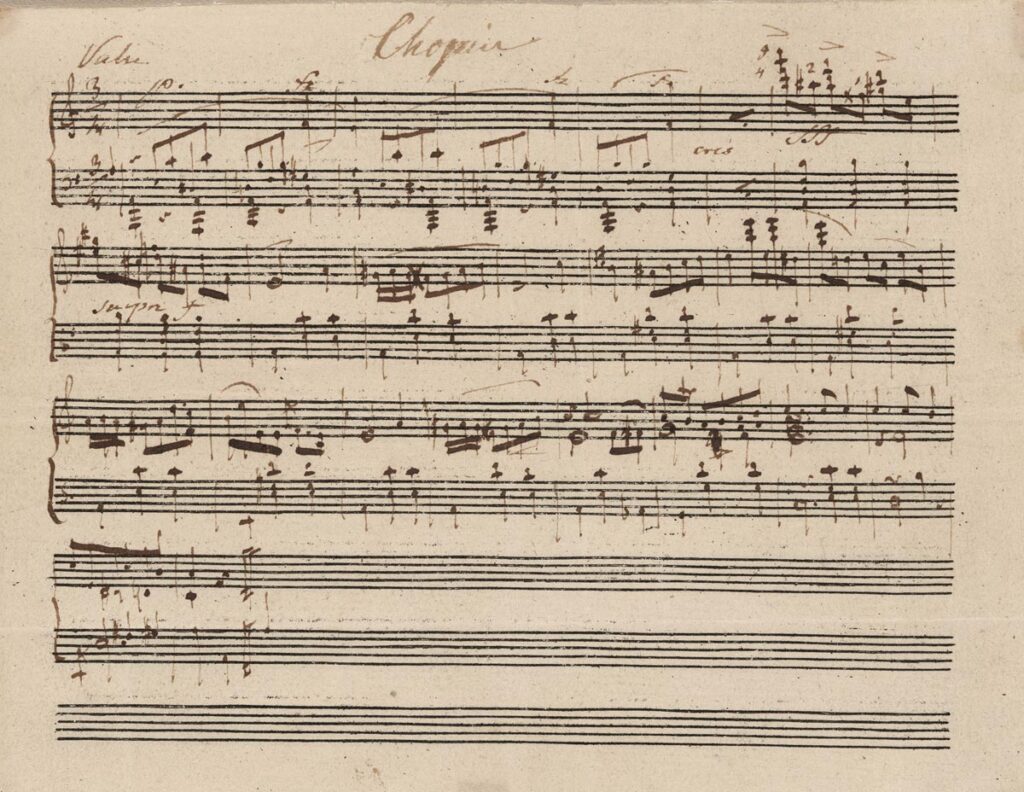
As yet another birthday passes, my thoughts once again turn towards the ever-closer shuffling off of my mortal coil. Still some way off, I hope, but there we go. Coupled with this, is the news that, trailing clouds of glory, composers never die. Some of them, in fact, refuse to allow something as mundane as death to prevent them from composing, and reach out through the ectoplasm to an almost musically-illiterate amanuensis. In other less paranormal cases, some clever curator finds some long-forgotten manuscript in some cupboard somewhere, an effective resurrection, a reaching-out from beyond the grave of a less literal kind. In this latest case, it is the late Frédéric Chopin, and twenty-something bars of a waltz purportedly by him, to pull a musicological Jacob Marley. I’m not a Chopin specialist, so I’m refraining from weighing in on that one until the dust has settled. But it has got me to a-thinkin’, nonetheless, so here, for better or worse, are those thoughts.
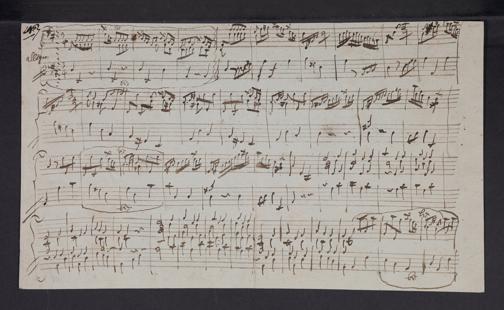
In January 2021, for instance, the Mozarteum Foundation in Salzburg announced a discovery that sent a tremor through the classical music community: a previously unknown piano piece by Wolfgang Amadeus Mozart, the Allegro in D major (K. 626b/16), had been identified. The manuscript, a single sheet of paper with hasty handwriting, was dated to roughly 1773, likely written during the composer’s teenage tour of Italy or immediately upon his return to Salzburg. The work itself is brief—a mere ninety seconds of music. It’s charming, structurally competent, and unmistakably Classical in style. Yet, structurally and aesthetically, it pales in comparison to the titanic masterpieces the world already possesses: the Jupiter Symphony, the Requiem, or the Don Giovanni.
Despite its relative musical insignificance, the discovery generated a disproportionate wave of euphoria. The premiere, performed by the acclaimed pianist Seong-Jin Cho, was streamed globally, and framed as a ‘special moment in music history’ by Rolando Villazón, the artistic director of the Mozartwoche. This reaction prompts a profound philosophical question: why does the emergence of a minor fragment excite the collective consciousness more than the profound, inexhaustible masterpieces we already possess? We have the smörgåsbord, yet we scrabble under the table for scraps. We barely comprehend the structural depth of the G minor Symphony, yet we celebrate the resurrection of a dance movement.
Prior to this, in 2011, an autograph album once owned by Arnold Wehner, director of music at Göttingen University, was auctioned in New York. Inside was a forgotten treasure: a short piano piece by Johannes Brahms, the Albumblatt in A minor, written in June 1853 as a personal contribution to Wehner’s collection. The announcement of its discovery in early 2012 drew immediate attention, not least because Brahms later reworked its theme into the Scherzo of his Horn Trio in E-flat major, Op. 40.
Again, the response was swift. Pianists such as András Schiff performed and recorded the miniature, giving 21st-century audiences the rare thrill of hearing ‘new’ Brahms. Critics described the piece as modest yet revealing, with hints of nostalgia that foreshadowed the composer’s mature style. The work even inspired orchestrations, including one by Iain Farrington, who expanded the sketch into a symphonic canvas.
Despite the piece’s brevity, the discovery of the Albumblatt was celebrated as a cultural event. Understandably. Few unpublished works by Brahms survive, and this rediscovery offered both scholars and listeners a fresh glimpse into his creative process—a reminder that even the smallest fragment can illuminate the continuity of a composer’s musical imagination, and that our relationship to history is fluid.
I posit that this fascination is not an aesthetic judgment but, rather, an existential defense mechanism. The discovery of a lost work functions as a secular resurrection, momentarily suspending the irrevocability of death. It serves as a totem against the finality of the grave, offering us the comforting illusion that the creative voice is not extinguished but merely dormant, waiting to be retrieved. The excitement is derived not from the quality of the music, but from the ontological shock of its existence. It is a manifestation of what we might term the ‘Lazarus Complex’—the desire to witness the return of the dead to validate our own hope for symbolic immortality.
The extreme limit-case of this phenomenon is surely the ‘mediumship’ of Rosemary Brown, a British housewife who, in the 1960s and 70s, claimed to transcribe ‘new’ works dictated by Liszt, Chopin, and Beethoven, inter alia. Analysing why even professional musicians and scholars—such as Humphrey Searle, Richard Rodney Bennett, and particularly Ian Parrott—were compelled to validate her output, I will explore the deep psychological structures that govern our relationship with the ‘dead masters’.
In this post, then, I examine the hypothesis that acceptance of music of, well, let’s be polite and say ‘questionable’ authenticity—as well as the widespread hullabaloo that accompanies the dusting-off of some piece of Palestrina discovered in a mouldy shoe-box in some dusty corner of a dusty cupboard in a dusty attic in the Vatican—is rooted less in the musical perfection of the discoveries themselves, and more in a psychological susceptibility to the ‘unfinished’ narrative. In short, I will argue that we prefer the ghost of a sketch to the reality of a masterpiece through a desire to believe that the Great Tradition, and by extension ourselves, can extend beyond biological, er, cessation.
The Anthropology of Death and Art
The disproportionate valuation of the ‘newly discovered’ results from the function of art in the face of mortality. The Great Composer is not merely a producer of entertainment; in a secular society, they function as a cultural hero, a figure who has achieved what the average individual cannot: the defeat of time.
Ernest Becker and the Terror of Mortality
In his Pulitzer Prize-winning treatise, The Denial of Death (1973), cultural anthropologist Ernest Becker argues that the defining characteristic of the human condition is the terrifying paradox of being a ‘god with an anus’—that is, a creature capable of contemplating the infinite and the eternal, yet housed in a biological vessel destined to decay and vanish. To manage the terror of this inevitable annihilation, human beings construct ‘immortality projects’ or ‘hero systems’. These are symbolic structures—religion, nation-states, and art—that allow the individual to feel they are part of something that will outlast their physical body.
Classical music, with its (admittedly problematic) canon of Immortals—Bach, Beethoven, Mozart, and ‘that crowd’, as Tom Lehrer put it—is a quintessential immortality project. We revere these figures because they have seemingly cheated death. Their voices remain audible centuries after their bodies have turned to dust. However, the death of the Hero is a trauma to the collective psyche. It shows us that even the greatest genius is finite.
The Posthumous Discovery as a ‘Vital Lie‘
Becker utilises the concept of the ‘vital lie’ (a term borrowed from Ibsen) to describe the illusions we maintain in order to function. The discovery of a posthumous work acts as a reinforcement of this vital lie. When a new piece of Chopin is found in 2024, or when Rosemary Brown claims Liszt is dictating to her in 1964, it psychologically negates the finality of death. It suggests that the boundary between the living and the dead is porous. The ‘new’ work provides a dopamine rush of relief. It whispers that the silence is not absolute. If the archive can yield a new Allegro, or if the ether can yield a new Grübelei, then perhaps the ‘End’ is not truly the End.
French philosopher Vladimir Jankélévitch, in his meditations on death, emphasises the ‘irrevocable’ nature of the event—the ‘he-will-never-do-anything-again’. Death is ‘sterile’ and ‘unproductive’. A posthumous discovery is a scandal to Jankélévitch’s concept. It is a production from the realm of non-production. We are excited by the minor work because it violates the sterilising inexplicability of death. It forces the irrevocable to revoke itself, if only for the duration of a piano miniature.
In Beyond the Pleasure Principle, Sigmund Freud posited that the aim of all life is death, but he also acknowledged the ‘compulsion to repeat’. The fascination with the posthumous is a compulsion to repeat the experience of the artist’s presence. We cannot accept that the corpus is closed. Likewise, Soviet philosopher Evald Ilyenkov’s ‘Cosmology of the Spirit’ envisions a final act of self-sacrifice to initiate a new cosmic cycle—a resurrection through destruction. The destruction of the artist’s life, then, is mitigated by the resurrection of their lost work. The discovery serves as a renewal, a way to pass through death and begin again.
This explains why we barely bother to understand the well-known music we already have. The well-known music is ‘finished’. It belongs to history. It is static. The discovered music is happening now. It belongs to the present. It offers the illusion that the composer is our contemporary, acting in our timeline, thereby granting us a share of their immortality.
The Aesthetic of the Fragment
The psychological preference for the ‘unknown minor’ over the ‘known major’ is further illuminated by the aesthetic philosophy of the fragment. The ‘masterpiece’ is often perceived as a closed system—perfect, polished, and impenetrable. The ‘sketch’ or ‘fragment’, however, is an open system that invites the participant to enter the creative process.
Georg Simmel and the Metaphysics of the Ruin
In his 1911 essay ‘The Ruin’, sociologist Georg Simmel articulates why we are drawn to decay and incompleteness. He argues that a building is a triumph of spirit over nature, a victory of human intention over matter and gravity. As the building decays into a ruin, nature begins to reclaim the spirit. Simmel posits that the ruin strikes us as ‘tragic but not sad’ because it represents a new unity: ‘destruction here is the realisation of a tendency inherent in the deepest layer of the existence of the destroyed’.
A lost musical work, recovered from an attic or a dusty library shelf, is a sonic ruin. It carries the marks of its survival. It has weathered the silence of history. Just as we value the moss on a Roman temple, we value the ‘lostness’ of the Mozart Allegro. Its aesthetic value is compounded by its temporal journey. It has survived the ‘shipwreck of time’. The finished masterpiece is dead in the sense that its history is written. The discovered minor work is alive because it is emerging. As the artist Arshile Gorky famously remarked, ‘When something is finished, that means it’s dead, doesn’t it? I believe in everlastingness. I never finish a painting—I just stop working on it for a while’.
Romanticism and the Fragment as Genre
As Ali Yansori explores, the preference for the unfinished is deeply rooted in German Romanticism. For thinkers like Friedrich Schlegel and Novalis (the so-called Jena Romantics), the fragment was not a failure of completion, but a distinct genre that pointed towards the Infinite. Schlegel compared a fragment to a hedgehog, ‘isolated from the surrounding world and bristling with spines on the outside’. It is complete in itself yet points to a ‘unity larger than its own’. He argued that Romantic poetry is ‘forever becoming and never perfected’. A finished work creates a boundary; an unfinished work suggests that the idea is too vast to be contained.
The work of Sappho (c. 630–570 BCE) is a famed example of genuine, ancient fragments. Some 650 of potentially thousands of lines are all that remain; the rest are lost to us because her work survives mostly on shredded papyrus or shards of broken pottery. Modern translations often preserve the visual gaps on the page, their incompleteness and ‘lost-forever-ness- somehow enhancing the poems’ emotional intensity.
In imitation of this, James Macpherson’s Fragments of Ancient Poetry (1760) is perhaps the most direct example of the Romantic tradition of the ‘faux-fragment’. His fifteen short prose poems, which he claimed were translated from ancient Gaelic manuscripts by a 3rd-century bard named Ossian, feature a melancholic tone, nature imagery, and themes of heroic tragedy and unrequited love—all Romantics’ favourite subjects!
During the nineteenth century, Romantic poets viewed the fragment as an intentional art form. They believed an incomplete work could capture the ‘infinite’ and the ‘sublime’ better than a finished one.
Percy Shelley’s ‘Ozymandias’, for instance, uses the motif of an ancient ruin to convey romantic themes of time and decay. Samuel Taylor Coleridge’s ‘Kubla Khan’ is presented as a fragment of a dream interrupted by a visitor.
The unfinished work requires the audience to mentally complete it. This act of co-creation fosters a deeper sense of intimacy, of proximity to the artist than the passive reception of a polished symphony. This is why, in direct contravention of a composer’s explicit wishes, fragments are published, sometimes completed and sometimes not, years or decades after the composer laid down his pen for the final time.
The Fetishisation of the ‘Hand’
This aesthetic flows into the psychological phenomenon of ‘essentialism’. Research in the psychology of art suggests that we value an original sketch by a master not for its visual/aural quality, but because we believe it contains the ‘essence’ of the creator—a form of contagious magic.
A doodle by Beethoven is valued higher than a masterfully composed symphony because the doodle provides a perceived direct link to the physical hand of the genius. The ‘known’ masterpiece, often experienced through recordings or modern editions, feels distant. The ‘manuscript discovery’ feels like touching the hand of the ghost.
As Kelly Baum of the Metropolitan Museum of Art noted, ‘an unfinished picture is almost like an X-ray, which allows you to see beyond the surface’. We prefer the sketch because we believe it reveals the truth of the artist’s mind, stripping away the artifice of the final polish.
The Curious Case of Rosemary Brown: A Tale of Mediated Authorship
If the discovery of a Mozart fragment is the passive form of this resurrection complex, the case of Rosemary Brown is its active manifestation. Brown did not merely find lost works; she claimed to generate them through direct communion with the dead. Her case provides a unique control study for understanding how far the musical establishment is willing to go to deny the finality of death.
The Housewife and the Lisztian Promise
Rosemary Brown (née Dickeson) was born in London in 1916. Her narrative begins with a classic foundation myth: at age seven (c. 1923), a spirit with long white hair and a black cassock appeared to her, promising, ‘When you grow up, I will come back and give you music’. It was only years later, upon seeing a photograph, that she identified the figure as Franz Liszt.
The fulfillment of this promise reportedly began in 1964. The timing is crucial. Brown was a widow (her husband died in 1961) and had recently lost her mother. She was living in a modest terraced house in Balham, South London, working as a school dinner lady. The socio-economic contrast—the ‘ordinary’ housewife versus the ‘transcendent’ genius—became a central pillar of her credibility. The narrative was perfect: the ‘Pure Vessel’, uncorrupted by ambition or excessive education, chosen by the Immortals.
(The term ‘pure vessel’—not entirely complimentary in Mrs Brown’s case, perhaps—refers to the idea of a person, body, or container being completely empty or cleansed so that it can hold or channel something greater. In Christianity, for instance, saints or holy figures are sometimes described as ‘pure vessels’ of God’s will, meaning they are cleansed of sin and able to carry divine grace. Likewise, practitioners of Hinduism and Buddhism may strive to become ‘pure vessels’ of enlightenment or compassion by removing ego and desire.)
Brown’s method of composition was described as dictation. Some composers would guide her hands on the piano keyboard, others would give her verbal instruction—she gratefully noted that Beethoven had ‘taken the time’ to learn English since dying!—or sing their works to her. The sheer volume of her output was staggering. She produced hundreds of works, including sonatas, impromptus, and etudes, attributed to virtually every major composer of the nineteenth century.
The Socio-Historical Hunger for the Irrational
Brown’s rise to fame in the late 1960s and early 1970s was not accidental. It coincided with what some might called the ‘disorienting transformation’ of modern post-WWII society. The era was characterised by the Cold War, the rise of rigid rationalism in urban planning, and the dominance of ‘high modernism’ (serialism, atonality) in academic music.
The musical establishment was polarised. The avant-garde (Stockhausen, Boulez) had declared melody dead. Audiences, however, still craved Romanticism. Brown’s ‘ghosts’ validated the audience’s taste: the spirits of the past returned to write melodies, implicitly criticising the ‘noise’ of the modernists. Liszt allegedly told Brown that modern music was ‘intellectually clever, but it is not music’. Even Stravinsky posthumously rejected his later serialist works, and gave her a nice, tonal Firebird-like ditty.
Historically, spiritualism surges during periods of mass death or social upheaval. While the 60s were not a war period in the UK, the rapid secularisation of society left a spiritual void. Brown offered a ‘scientific’ proof of the afterlife through tangible musical artifacts.
Why the Professionals Believed, or the Epistemology of Expertise
The most perplexing aspect of the Rosemary Brown phenomenon is not that she made the claims, but that she was validated by figures of significant musical standing. Why did highly trained ears not immediately dismiss her work as amateurish pastiche? The answer lies in a combination of the ‘Uncanny Valley’ of style, the ‘Pure Vessel’ theory, and perhaps the experts’ own desire for the survival of their tradition.
Validation by Obscurity—The ‘Grübelei’ Trap
The strongest card in Brown’s hand was a piece titled Grübelei (‘Brooding’), attributed to Franz Liszt.
In the 1960s, Liszt was popularly known for his ‘middle period’ virtuosity—flashy Hungarian rhapsodies and operatic paraphrases. His ‘late style’ (works from the 1880s like Nuages Gris or Bagatelle sans tonalité) was obscure, experimental, sparse, and largely unrecorded. It anticipated 20th-century atonality.
Grübelei did not sound like the popular ‘Liebestraum‘ Liszt. It was complex, harmonically ambiguous, and featured a difficult cross-rhythm (one hand is written in 5/4, the other in 3/2). Humphrey Searle, a leading British composer and Liszt scholar, was astounded. He noted that the piece bore the specific hallmarks of Liszt’s experimental late style—a style Brown, with her limited background, should not have known existed.
If Brown were a fraud, she likely would have composed a pastiche of ‘famous’ Liszt (glittering arpeggios, grand melodies). By producing a work that sounded ‘wrong’ to the layman but ‘right’ to the scholar, she bypassed the expert’s scepticism. The reasoning: ‘She couldn’t possibly know about late Liszt; therefore, this must be genuine.’
The ‘Pure Vessel’ Defense
Composer and Professor Ian Parrott became Brown’s academic champion, writing a book titled The Music of Rosemary Brown (1978). Parrott constructed a theological/musicological defence based on the ‘Pure Vessel’ theory. A trained composer would be a bad medium because their own training, ego, and muscle memory would interfere with the transmission. The spirits needed an amateur. Brown reported Liszt saying, ‘a musical background would have caused you to acquire too many ideas and theories of your own’. This created a non-falsifiable loop. Brown’s technical incompetence (she struggled to play the pieces she wrote) was cited not as evidence of fraud, but as proof of authenticity. Her ‘unfettered’ mind was the perfect tabula rasa.
Amongst the believers, Richard Rodney Bennett remarked, ‘if she is a fake, she is a brilliant one, and must have had years of training’. He admitted that ‘some of the music is awful’, but ‘some is marvelous’. Leonard Bernstein, Brown claimed, was so impressed by her ‘Rachmaninoff’ that he treated her to dinner at the Savoy, and played the pieces she had notated with ‘great brilliance’. While Bernstein remained sceptical of the ghosts, he validated the quality of the music as being beyond her apparent means. In a bizarre meta-twist, the spirit of the famous music critic Donald Francis Tovey allegedly communicated to validate the project, stating ‘it is the implications relevant to this phenomenon that we hope will stimulate sensible and sensitive interest and stir many who are intelligent and impartial to consider and explore the unknown of man’s mind and psyche’. Tovey was never one for nonsense and silliness.
Not all were convinced. Prior to the release of an LP ‘A Musical Seance’, Time published a snide feature. André Previn dismissed the works, saying that even if they were genuine, they were ‘best left on the shelf’. Denis Matthews, writing in The Listener (1969), called them ‘charming pastiches’. Sceptics argued that Brown was a ‘cryptomnesic’ savant. She may, they said, have absorbed musical structures during her early piano lessons and subconsciously reworked them. The pieces were often described as lacking the masters’ ‘developmental’ rigour, relying instead on repetition, a hallmark of amateur improvisation.
The fact that the ‘posthumous Stravinsky’ wrote in a Romantic style (claiming he abandoned serialism) was seen by sceptics as proof that the ‘spirits’ were limited by Brown’s own aesthetic preferences. The ghost of Stravinsky sounded suspiciously like Rosemary Brown.
Musicological Forensics
While he was a PhD student, Érico Bomfim (the pianist in the video above) conducted a detailed analysis of a Sonata in F minor attributed to Schubert. His findings suggest that the mimicry went deeper than surface melody. Schubert’s treatment of sonata form is distinct from, say, Beethoven’s. Schubert often uses three-key expositions and lyrical, wandering developments rather than motivic fragmentation. Bomfim found that Brown’s ‘Schubert’ adhered to these specific, idiosyncratic structural markers. For Brown to fake this, she would need a deep theoretical understanding of Schubertian form. The ‘essence’ of Schubert was present. This supports the ‘savant’ theory—that Brown possessed a high-level intuitive grasp of musical architecture, even if she lacked the vocabulary to explain it.
Humphrey Searle’s analysis of Grübelei noted that the piece used a ‘new scale’, derived from the Verbunkos/Hungarian minor, that Liszt favoured in his late years for generating experimental harmonies. (Brown herself called this ‘new scale modulations’.) The coincidence of an amateur housewife inventing a scalar system identical to one used by the elderly Liszt was the ‘smoking gun’ for her supporters.
The Gendered Medium: The Housewife as Oracle
The Rosemary Brown phenomenon cannot be decoupled from her gender and social class. The press relentlessly emphasised her status as a ‘suburban housewife’, a ‘widow’, and a ‘mother’. Her persona was built on ‘utter normality’. She disarmed sceptics by claiming no ambition. By positioning herself as a passive vessel—a ‘secretary’ to the greats—she insulated herself from the criticism usually levelled at female composers.
In the 1960s, female composers still faced significant barriers to entry in the classical canon. By claiming the music was by Liszt (a man), Brown bypassed the gender bias. She utilised the trope of the ‘spiritual medium’—a role historically dominated by women—to gain a voice in the male-dominated world of composition.
Moreover, stories of her ‘shopping with Liszt’ or ‘watching TV with Chopin’ domesticated the terrifying concept of death. It made the afterlife seem like a continuation of suburban life. This banalisation of the sacred was key to her mass appeal.

Scarcity, Value, and The Market of the Dead
While some of the excitement of a new discovery comes from knowing something others missed, not all of the excitement is purely spiritual; it is also economic and possessive. The Unknown Work represents a commodity of infinite scarcity. The narrative of ‘Art Found in Attic’ drives a massive sector of the art market. It appeals to the lottery mentality. To discover a work is to outsmart history, and to outsmart the economy.
Research has shown that while ‘masterpieces’ often underperform the market (due to already inflated prices), ‘discoveries’ offer massive returns. A sketch bought for £50 that turns out to be a Constable is the ultimate capitalist fairytale.
The Fetish of Originality
Psychological studies confirm that the ‘original’ is valued because of the perceived physical connection to the artist. We value the sketch because the artist held it. The music of the Allegro is secondary to the paper of the Allegro. The paper proves Mozart was there. Likewise, Brown’s manuscripts were scrutinised for handwriting. The fact that her handwriting (allegedly) changed to match the composers’ was a major selling point. It was physical proof of ‘possession’.
The Lazarus Complex and the Denial of Silence: The Final Paradox
Why are we so excited by the discovery of something trivial? More so than by the better understanding of something already known to us? Is it our inability to accept the finality of death, that the discovery is a kind of resurrection?
The evidence, it seems to me, overwhelmingly supports this conclusion. The phenomenon of the Recently Discovered Minor Work and the case of Rosemary Brown are symptoms of the Lazarus Complex. We fear the silence of the great artist because it prefigures our own silence. If Mozart can cease to create, then we can cease to exist. A new work breaks that silence. It is a transmission from the void.
If an artist can ‘speak’ from beyond (either through a medium like Brown or through a time-capsule discovery like the Chopin Waltz), it validates the dualistic concept of the Soul—that the creator is distinct from the biological body. A discovered work is a survivor. It almost didn’t make it. Its existence is a near miss, a triumph over entropy.
The professional musicians who validated Rosemary Brown did so not because they were fools, but because they were mourners. In the cold, mathematical light of 1960s Serialism, the spirits of Brown brought back the warmth of nineteenth-century tonality. The experts wanted to believe that the Great Tradition had not ended with Schoenberg. They forgave the musical flaws because the narrative—that Art survives Death—was too intoxicating to reject. As Sir Donald Tovey said (via Brown), the point was the implication.
The Jupiter Symphony is too large, too perfect, and too ‘finished’. We struggle to understand it, and it does not need us to. The Waltz in A minor and Grübelei need us. They need our validation, our excitement, and our belief to exist. In rescuing these minor works from oblivion, we are not saving the music; we are trying to save ourselves. We prefer the ghost of the sketch to the reality of the masterpiece because the ghost promises us that the story is not over.
The excitement of the discovery is the excitement of the open door. It is the refusal to accept the word: Fine.